A key change is the moment a song moves its home note somewhere else and carries on, and it is one of the oldest tricks in music: the lift before the last chorus of a pop ballad, the second theme of a classical sonata, the sudden new colour halfway through a film cue. Pop number ones used to change key all the time and almost stopped, which is its own story. This guide covers what a key change is and how it differs from a borrowed chord, the ways songs change key, the famous last-chorus lift and the well-documented songs that use it, why the key change nearly disappeared from the charts, how classical music builds whole movements on them, how to hear one, how a key finder shows one and where it can be fooled, and how to mix around a song that changes key.
A key change moves the home note, and the song keeps going
Every key has a home note, the tonic, that the music rests on. A key change, which musicians call a modulation, is a longer-term change of that tonic: for a while, the song rests somewhere new. Open Music Theory, a free university textbook, defines modulation as exactly that, a longer-term change of tonic, and gives the practical test: cadences establish keys, and the same new accidentals keep repeating.
The distinction that matters is between a real key change and a borrowed moment. Wikipedia's article on modulation calls the shorter version tonicization: treating a chord as a temporary home for less than a phrase. A song in C major that visits D major for a bar on the way to G is tonicizing; a song that moves to D major for the whole last chorus has modulated. The difference is duration and commitment, and it matters because your ear, and any key finder, should treat them differently.
One related move is often called a key change but technically is not. Switching from C major to C minor keeps the same home note and changes the scale; Wikipedia's article describes that as a change of mode rather than a modulation. It sounds like a big shift in mood, but the note the song rests on stays put.
Four ways songs change key
Music theory names several techniques. These are the ones you will hear most, as the Wikipedia article and Open Music Theory describe them.
| Technique | How it works | What it sounds like |
|---|---|---|
| Pivot chord (common chord) | A chord that belongs to both keys is heard in the old key and continued in the new one | Smooth: you notice you have arrived rather than the moment of moving |
| Direct, or phrase, modulation | The old key ends a phrase, and the next phrase simply starts in the new key with no transition | Obvious and deliberate: the classic pop lift |
| Chromatic | One note of a chord is raised or lowered, keeping its letter name, to lead into the new key | A slide into a more distant key |
| Enharmonic and common tone | A chord is respelled as a chord of the new key, or a single held note bridges the two | Surprising: often a jump to a key that feels far away |
A pivot chord, worked through
The pivot chord is easier to hear than to describe. In C major, the chord A minor is the sixth chord, vi. In G major, the same A minor chord is the second chord, ii. So a progression can run C, F, A minor in C major, then treat that A minor as the ii of G and continue with D major and G. The ear accepts the A minor as belonging to C when it arrives, then hears D major lead to G as a new home. Nothing jars, because the chord at the hinge belongs to both keys. That is why the dominant, which shares six of seven notes with the home key, is the easiest key to reach this way.
Most modulations go to closely related keys. The Wikipedia article notes that the dominant, the key a fifth above, is the most frequent destination, and that in minor keys the relative major is common too. On a Camelot wheel, those are the neighbouring positions: one hour clockwise, or the other ring at the same hour.

The last-chorus lift: up a step for the final chorus
The most famous key change in popular music is a direct modulation near the end of a song: the band stops, or barely pauses, and the last chorus comes back a semitone or a whole tone higher. It has a mocking nickname, the truck driver's gear change, which Wiktionary lists as derogatory slang for repeating an earlier section transposed higher. Nobody reliably knows who coined it; the most repeated story traces it to a tongue-in-cheek website that no longer exists.
It works because the ear hears the higher chorus as more intense, and a singer reaching higher sounds more urgent. It is criticised for the same reason: it adds excitement without writing anything new. Either way, it is everywhere in the music of the 1980s and 1990s. These examples come from each song's Wikipedia article, which cite published sheet music:
| Song | The move | When |
|---|---|---|
| Michael Jackson, "Man in the Mirror" | G to A♭, up a semitone | At about 2:53 |
| Whitney Houston, "I Wanna Dance with Somebody (Who Loves Me)" | G♭ to A♭, up a whole tone | At about 3:12 |
| Whitney Houston, "I Will Always Love You" | A to B, up a whole tone | At about 3:31 |
| Beyoncé, "Love On Top" | Four changes, each up a semitone: C, D♭, D, E♭, E | Across the final choruses |
| Celine Dion, "My Heart Will Go On" | E to A♭ | Near the end |
| Bon Jovi, "Livin' on a Prayer" | E minor to G minor, up a minor third | The final chorus |
The last example shows why you should check sources. Chris Dalla Riva, the writer whose analysis of number ones is covered below, groups "Livin' on a Prayer" with the half-step and whole-step lifts, while its Wikipedia article, citing the sheet music, gives E minor to G minor, a bigger jump. Both agree it lifts the last chorus; they disagree on how far.
Why the key change nearly disappeared from the charts
Key changes used to be routine in hit songs, and then, fairly suddenly, they were not. The best data comes from Chris Dalla Riva, who analysed all 1,143 number ones on the Billboard Hot 100 from 1958 to 2022. In his 2022 article for Tedium, he found that 23 percent of number ones from 1958 to 1990 were in more than one key, and that 52 percent of those key changes were a half-step or whole-step lift near the end. After 1990 key changes became far rarer; in the 2010s, the only number one he found with one was Travis Scott's "SICKO MODE", which moves down rather than up. NPR's reporting on his work put it at about a quarter of number ones in each decade from the 1960s to the 1990s.
His 2025 update on his own newsletter refines the numbers: from 1960 to 1995, 20 to 35 percent of number ones each year had a key change, falling to none by the end of the 2000s, and from 2015 to 2025 only five number ones had one, including BTS's "Dynamite", which moves from E to F♯. He also puts the share of last-chorus lifts at 60 percent for 1960 to 1990, a little higher than his earlier figure.
Why it happened is harder to prove than that it happened. One plausible reason, and it is only a reason we find convincing, not a measured one: much popular music since the 1990s is built on loops, a repeating chord pattern or sample under the whole song, and a loop does not change key easily. Hip hop and electronic music, which dominate the charts, are built that way. A key change also works best when a song has a big final chorus to lift, and songs built on a steady groove often do not.
For anyone writing songs now, the rarity is an opportunity. A device heard in a quarter of hits becomes a cliché; a device heard in almost none stands out. A well-prepared key change in a modern pop song is noticed precisely because listeners are no longer expecting one, which is part of why the few recent number ones that use one are the ones people talk about.
In classical music, the key change is the structure
Pop uses key changes as a moment; classical music uses them as architecture. In sonata form, the structure of most first movements of symphonies and sonatas, the move to a new key is what separates the first theme from the second. Open Music Theory's chapter on sonata form says the secondary theme is in a non-tonic key, typically the dominant for major-key pieces and the relative major for minor-key pieces, and the development section that follows travels through several keys before the music returns home.
That makes classical recordings a good test for anyone learning to hear modulations, and for a key finder. We ran two public-domain and openly licensed recordings through our key finder, reading the first two minutes of each.
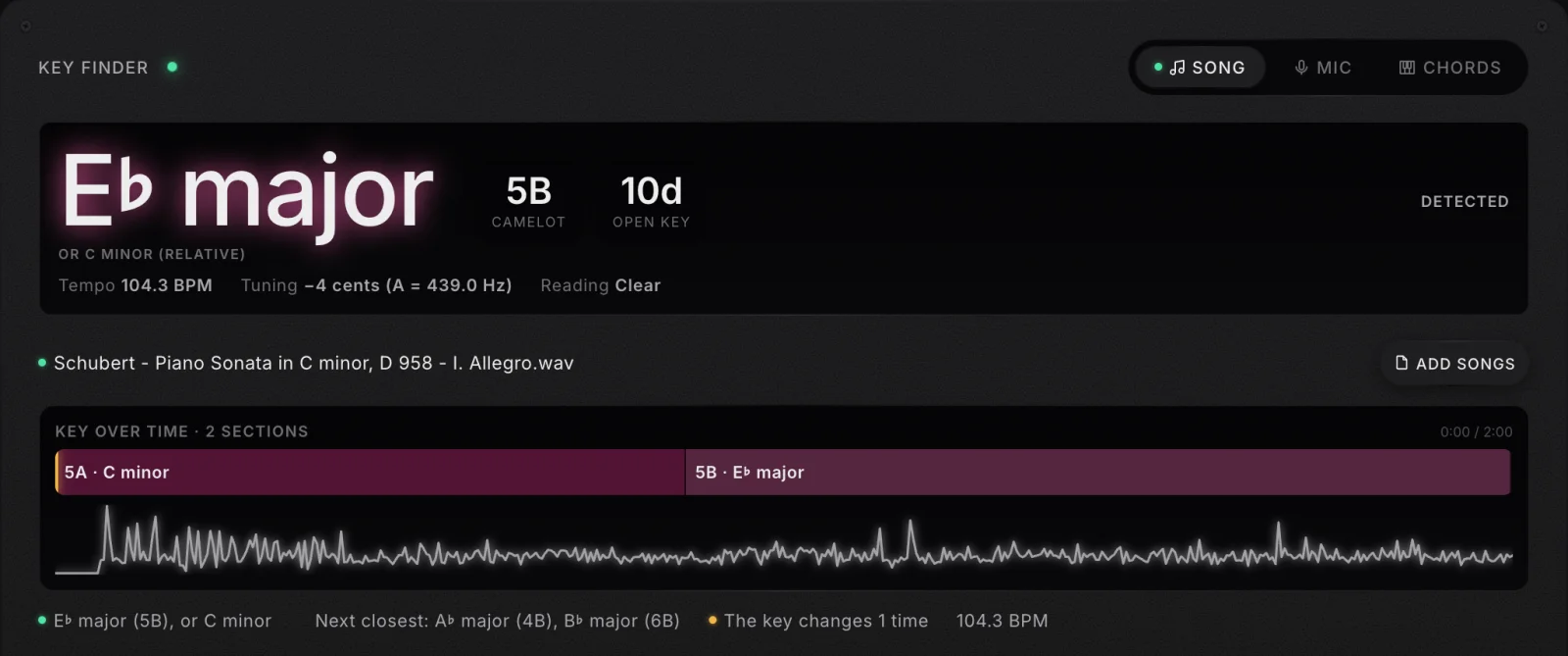
Schubert's C-minor sonata does exactly what the textbook says a minor-key sonata does: the finder reads C minor for the opening and E♭ major, the relative major, from about 51 seconds. Bach's first cello suite is not a sonata, but its famous prelude makes the other textbook move, to the dominant: the finder reads G major until about 1:07, then D major.
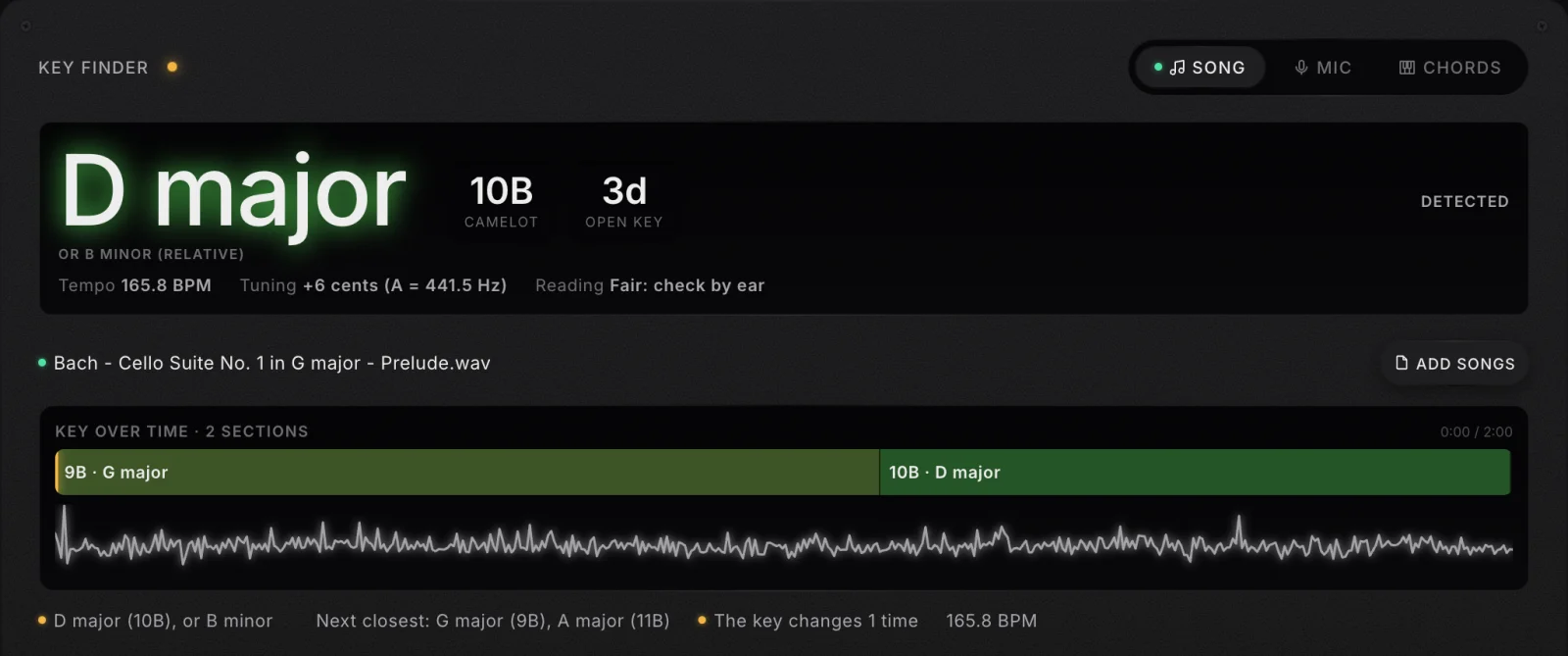
Notice the headline in both. The finder names the key the excerpt leans on overall, which in these two minutes is the second key, because the second section is long and harmonically clear. The piece is still in C minor and G major; the timeline is what tells the real story. That is the general lesson for songs that modulate: one key name is not enough.
The same two recordings make a good ear-training pair: listen to the first minute of each, then skip to just after the change the finder marks, and notice how the music settles somewhere new without any jolt. That smoothness is the pivot-chord technique at work.
How to hear a key change
You do not need theory to notice a modulation. Four signs give it away:
- The home note stops fitting. Hum the note the verse rested on. If it suddenly sounds wrong against the chorus, the home has moved.
- A cadence lands somewhere new. The strongest sign in Open Music Theory's list: a phrase ends with a clear resolution on a chord that is not the old home.
- New sharps or flats keep coming back. One odd note is a passing colour; the same new note repeated for a whole section is a new key.
- A lift you can feel. The last-chorus change is obvious because the whole band moves up at once, often after a pause or a drum fill.
A listening exercise
Take two songs from the table above, one with a semitone lift and one with a whole-tone lift. Play each from the chorus before the change and hum the chorus's home note as it ends. When the last chorus arrives, keep humming the old note: in the semitone lift it will feel slightly flat against the band, in the whole-tone lift clearly flat. Then find the new home note and hum that instead. Doing this with two or three songs trains the ear faster than any explanation, because you feel the home move under you.
If you play an instrument, test it: play the old key's home chord over the new section. If it clashes for the whole section, not just for a chord or two, the song has modulated.
How a key finder shows one, and where it can be fooled
Most key finders give one answer for a whole song, and for a song that modulates that answer is at best half right. Worse, averaging two keys can land on a third: a song that moves from C major to D major can average out near G major, the key between them, which the song never plays.
Our free key finder reads the key section by section to avoid that. It scores the song in windows of 16 seconds, moving 8 seconds at a time, then finds the path through the keys that fits best while charging a cost for every change, so it only reports a new key when the new key holds long enough to be real. It draws the result as a coloured strip with the Camelot code on each section, and says how many times the key changes.
That design has limits worth knowing:
- Short visits do not show. A bar or two in another key, the tonicization described earlier, is absorbed into the surrounding section. That is deliberate: a borrowed chord is not a key change.
- Boundaries are approximate. With 16-second windows, the change is placed within a few seconds of where it happens, not on the exact beat.
- Close keys are hardest. A move to the relative key shares every note, so it shows less clearly than a move up a semitone.
- Modes are not keys. A switch from major to minor on the same home note, the change of mode, shows as two different keys, because the finder only knows major and minor.
Read the headline and the strip together. The headline is the key the whole song, or excerpt, leans on; the strip shows the sections. If they disagree, trust the strip for DJ planning and playing along, and the headline only as a summary. If the strip has one section and the reading is Clear, the song almost certainly stays in one key.
Our guide to finding the key of a song covers how the finder reads a key in the first place, and why the relative key and the key a fifth away are its most common near misses.
Mixing around a song that changes key
For DJs, a modulating track is a trap: you mix into it in one key and out of it in another. Three habits keep it from biting.
- Know the key at both ends. The key timeline shows the intro's key and the outro's key. Plan the next track from the outro's key, not the headline.
- Mix out after the change, or before it. If the lift comes in the last chorus and the outro drops back to drums, mix during the drums, where no key clashes.
- Use the lift. A track that rises a semitone at the end has done the energy boost for you. The next track in the new key, one hour on the Camelot wheel from it, continues the climb. Our guide to the Camelot wheel covers the moves.
Writing a key change of your own
- Decide what it is for. A lift for the last chorus wants a direct move up a semitone or a whole tone. A contrasting bridge wants a closely related key, the dominant or the relative, reached smoothly.
- Prepare it or announce it. For a smooth move, find a pivot chord both keys share. For a lift, a drum fill, a one-beat pause or a single chord from the new key, its dominant, announces it.
- Check the singer's range. A whole-tone lift on a chorus that already reaches the top of a voice is a problem the listener will hear.
- Decide whether to come back. A lift for the last chorus usually stays up to the end; a bridge in another key usually returns home for the final section.
Where to get it: free tools
- Song key finder. Free, in your browser, nothing uploaded. The key section by section, so a key change shows where it happens, with Camelot and Open Key codes, the tuning and the tempo; also from the mic or typed chords.
- BPM finder. Free, in your browser: the tempo, with half and double time, from a file, the mic or tapping.
- Live audio visualizer. Free, in your browser: visuals that react to a song or your mic, recorded up to 60 seconds with a small immer ground mark.
- ImmerGround for iPhone, iPad and Mac. Our app, free to download; ImmerGround Pro is $6.99 a week or $39.99 a year. Visuals that follow the music live, on your own clips and photos. It reacts to the sound, not the key.
What to do next
- Listen for the lift. Put on one of the songs in the table and wait for the last chorus: once you have heard the gear change deliberately, you will hear it everywhere.
- Run a song you suspect through the key finder. Look at the strip, not the headline.
- Check it by ear. Play or hum the old home note over the new section; if it clashes throughout, the key has changed.
- For DJ sets, note the outro's key. Plan the next track from where the song ends, not where it starts.
- Try one yourself. Lift the last chorus of a song you are writing by a whole tone and hear how much it changes the ending.